about
At the end of the day, burglaries and related criminal activity as defined by the law is because communities are under-resourced due to historical, persistent disinvestment and malicious segregation and policies. Issues like this are far beyond what only relying on technology and numbers can do.
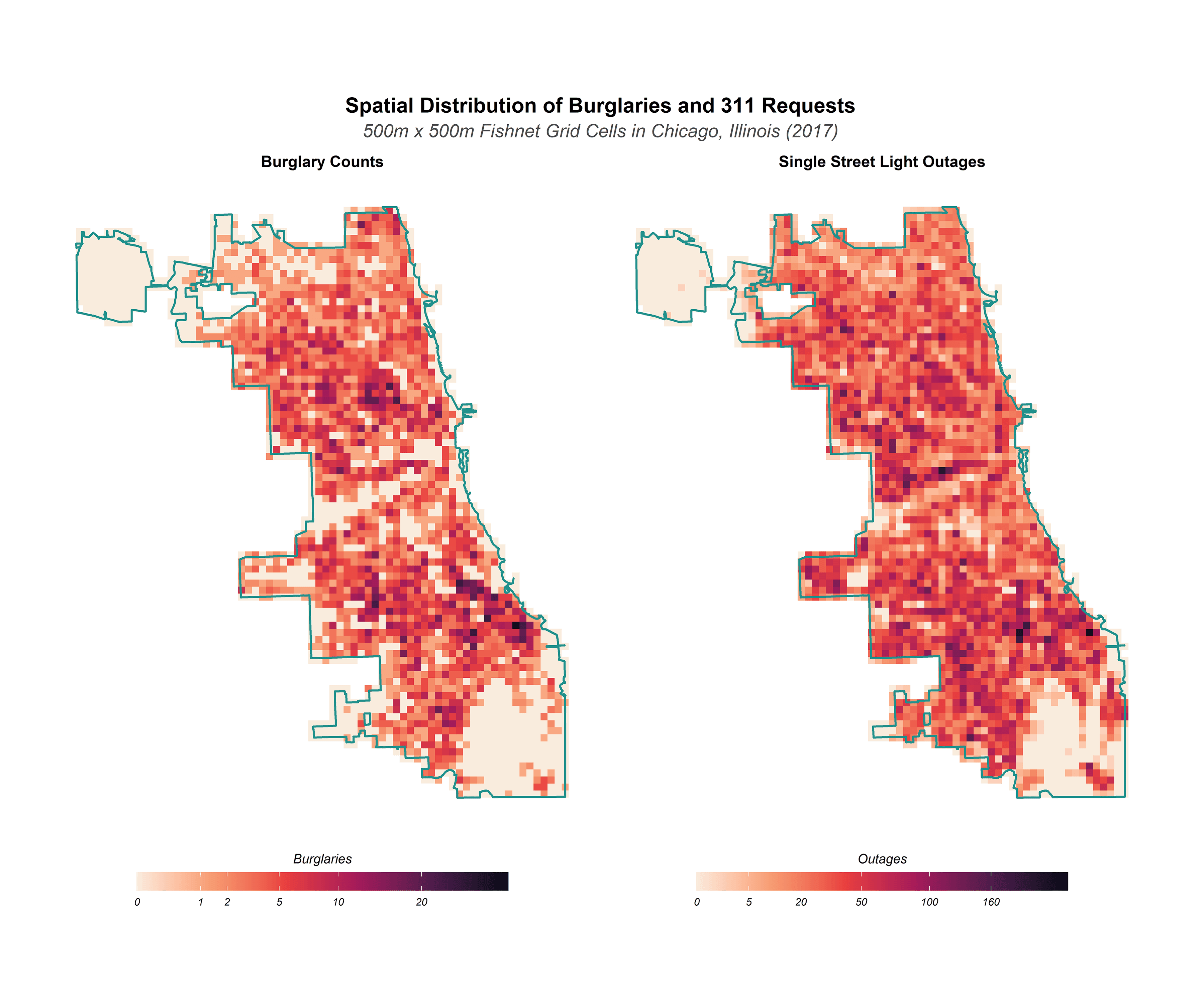
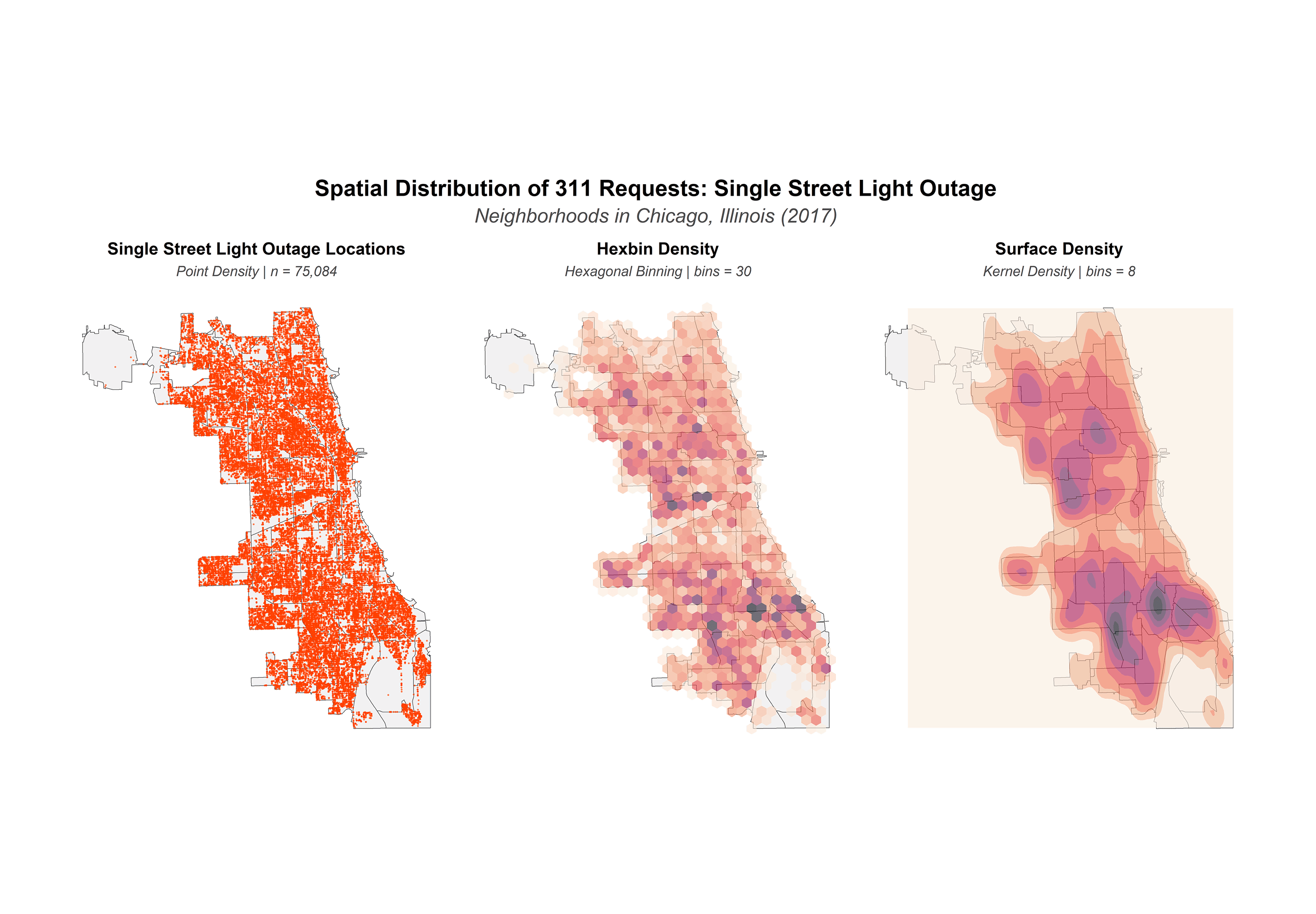
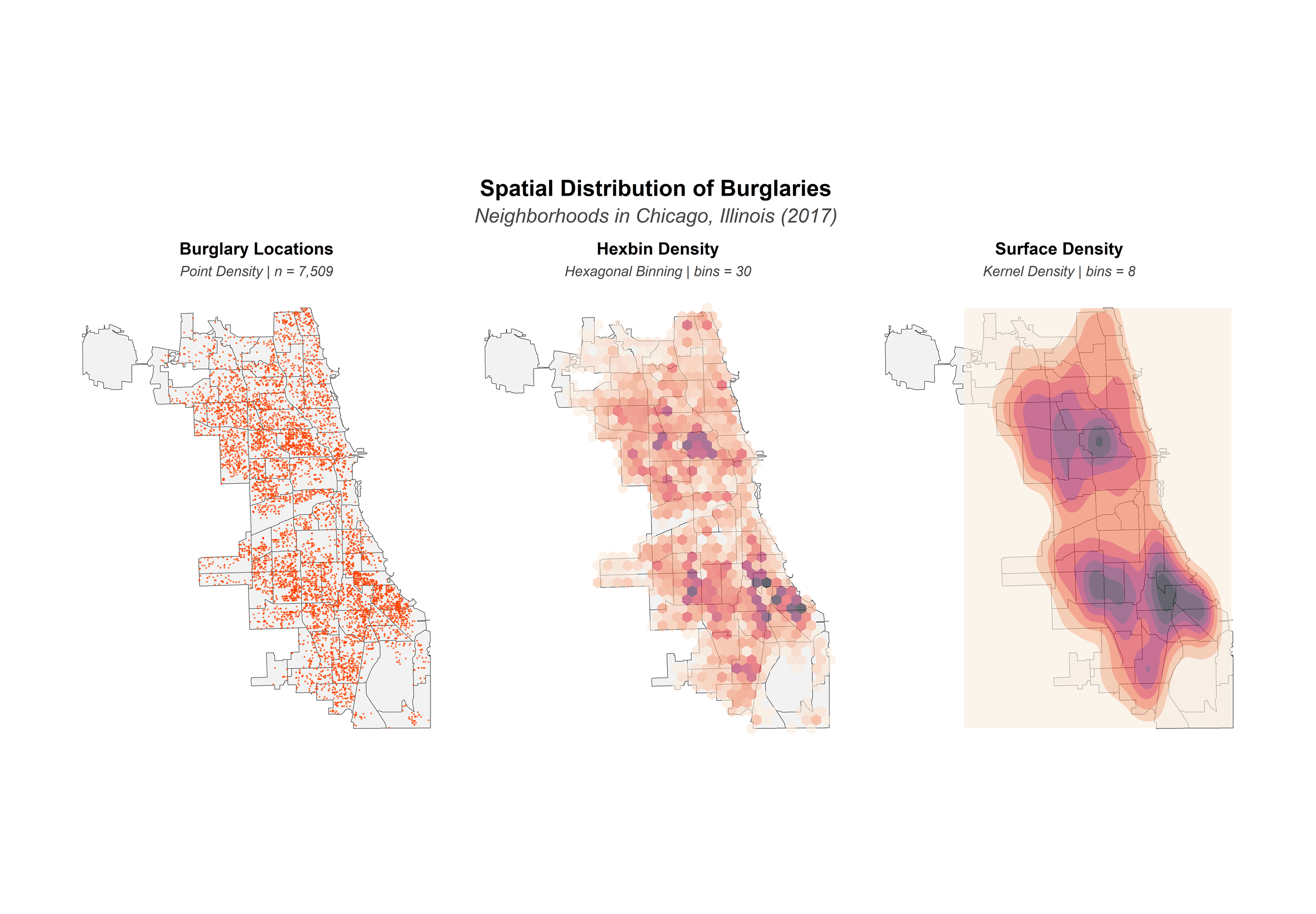
This project develops a spatial predictive model for forced-entry burglaries in Chicago, specifically designed to test the viability of "ethical" predictive policing. Unlike traditional models that often rely on biased demographic data (arrest records or census demographics), this workflow restricts predictors strictly to the built environment and 311 service requests. The core hypothesis tests whether physical signs of neighborhood disinvestment—specifically "Street Light - One Out" complaints, which imply a lack of guardianship without the bias of nuisance reporting—can effectively predict burglary hotspots. The goal is to shift the focus from policing individuals to maintaining urban infrastructure.
The analysis is conducted in R, utilizing the sf package for vector processing and tidyverse for data engineering.
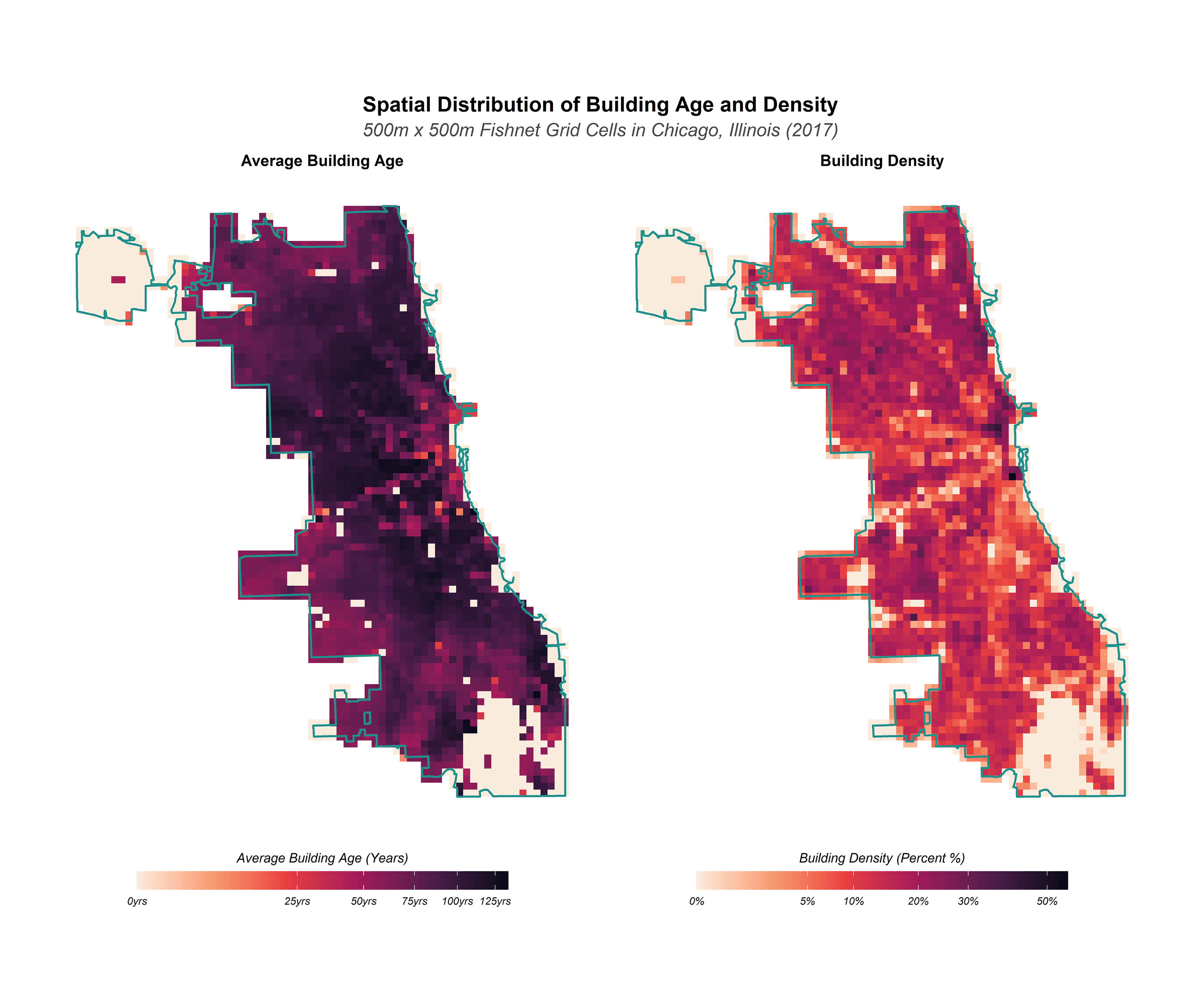
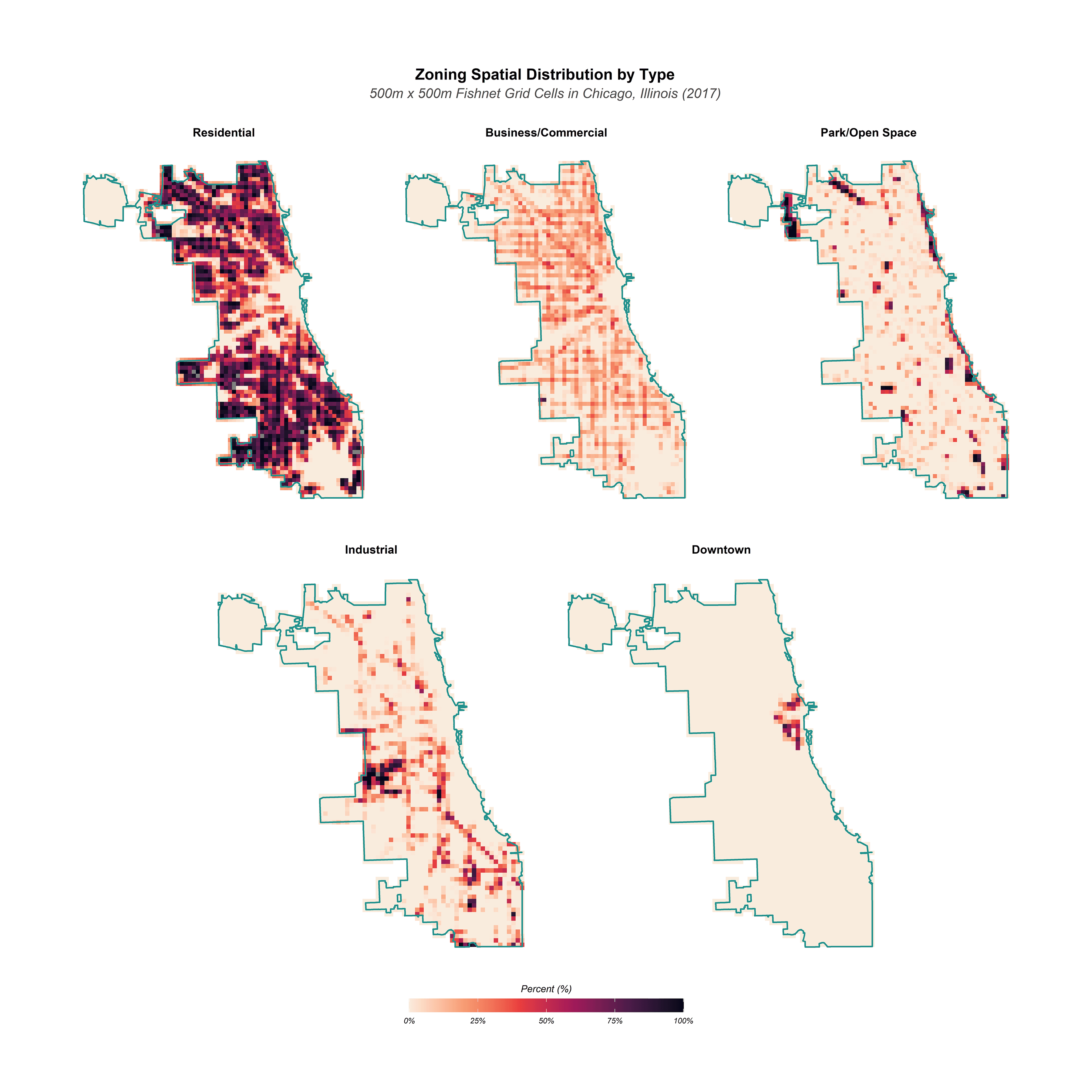
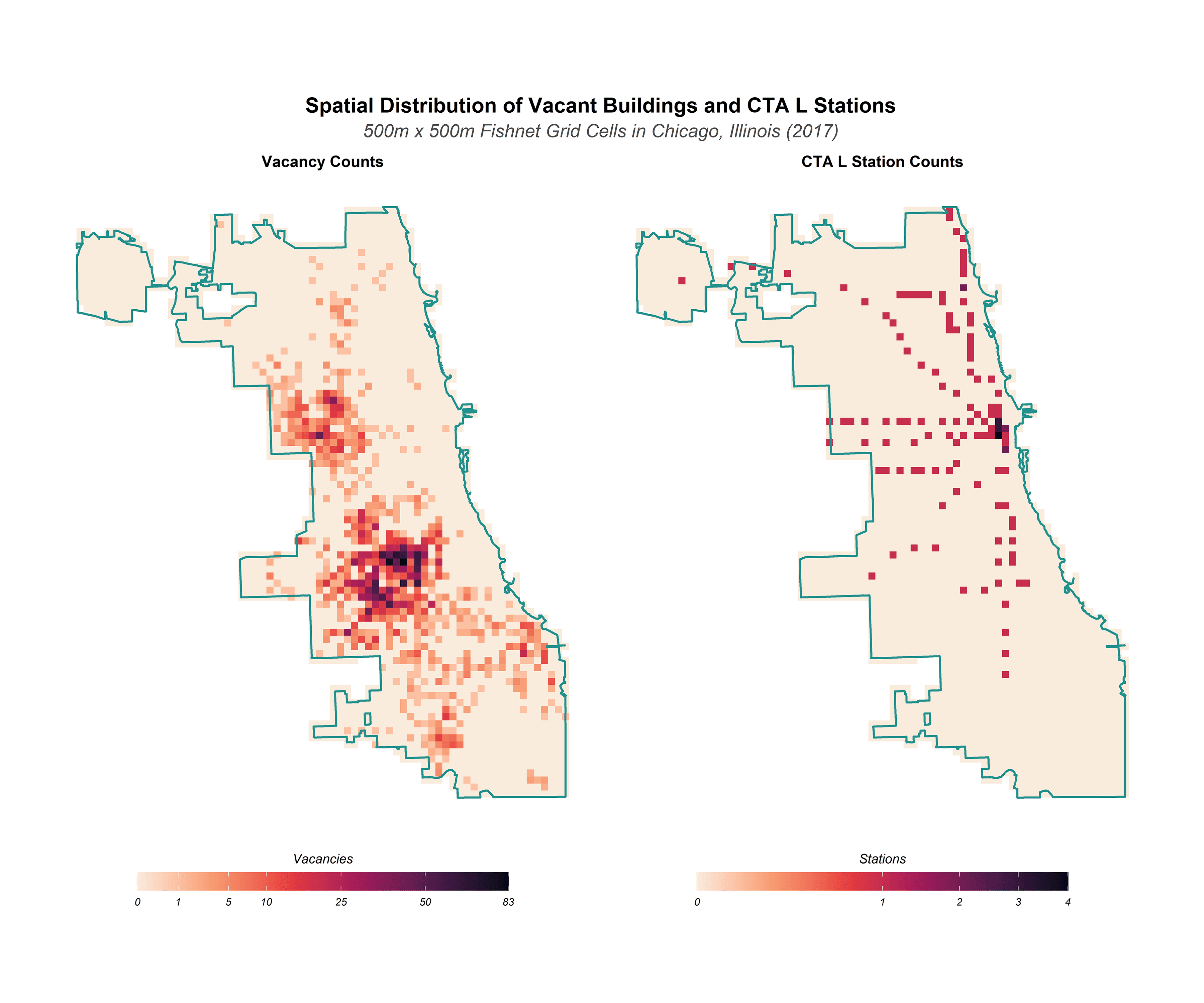
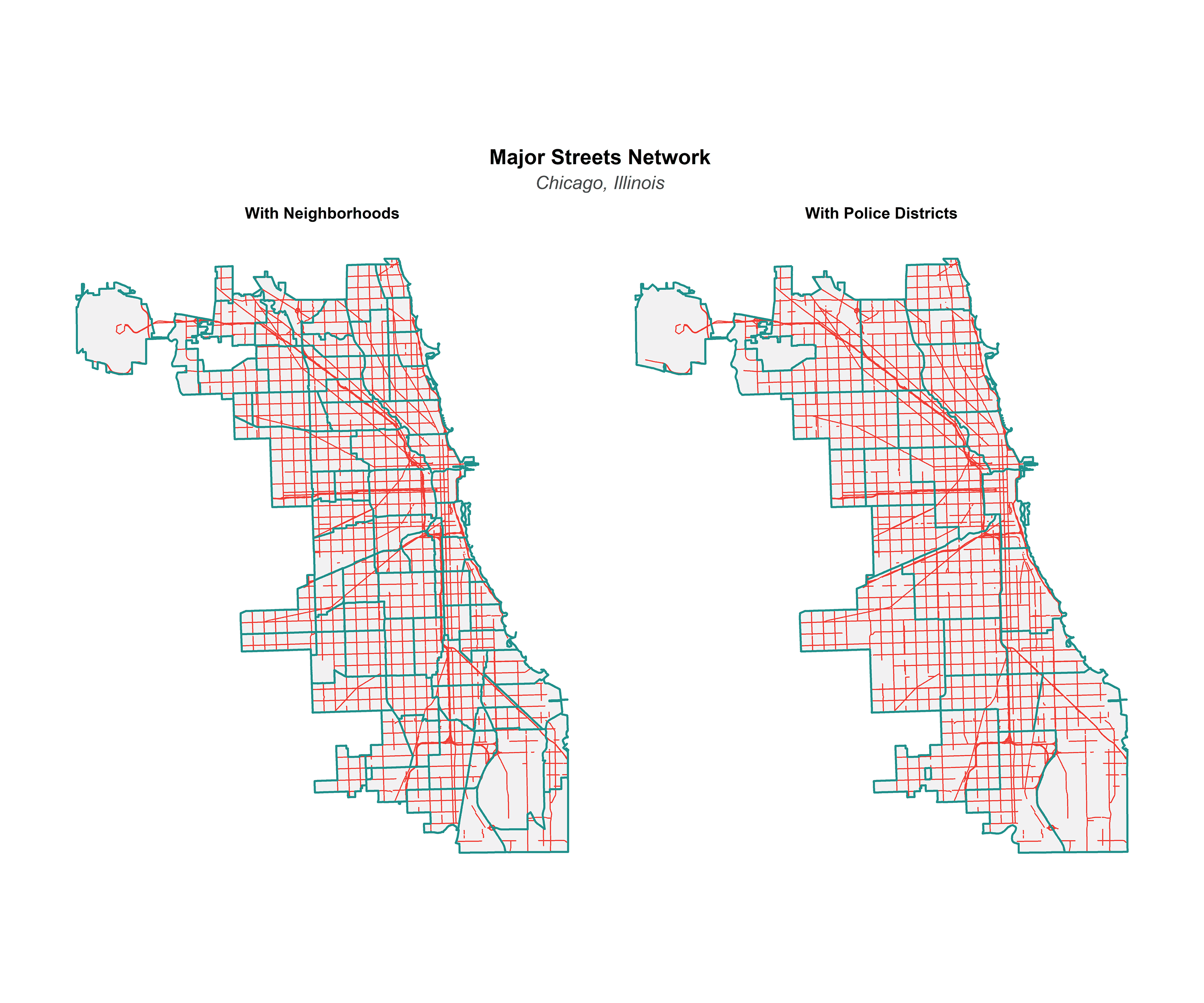
Spatial Engineering: The city is divided into a 500m x 500m fishnet grid to standardize the modifiable areal unit. Feature engineering involves calculating distance matrices to major streets and transit (CTA L stations), aggregating zoning types (Residential vs. Commercial), and deriving building metrics (age and density).
Feature Selection: A key predictor, the "Street Light Outage" hotspot, is generated using Local Moran's I to identify statistically significant clusters of infrastructure neglect.
Modeling Strategy: The study compares Poisson and Negative Binomial (glm.nb) regressions to handle the over-dispersed count data.
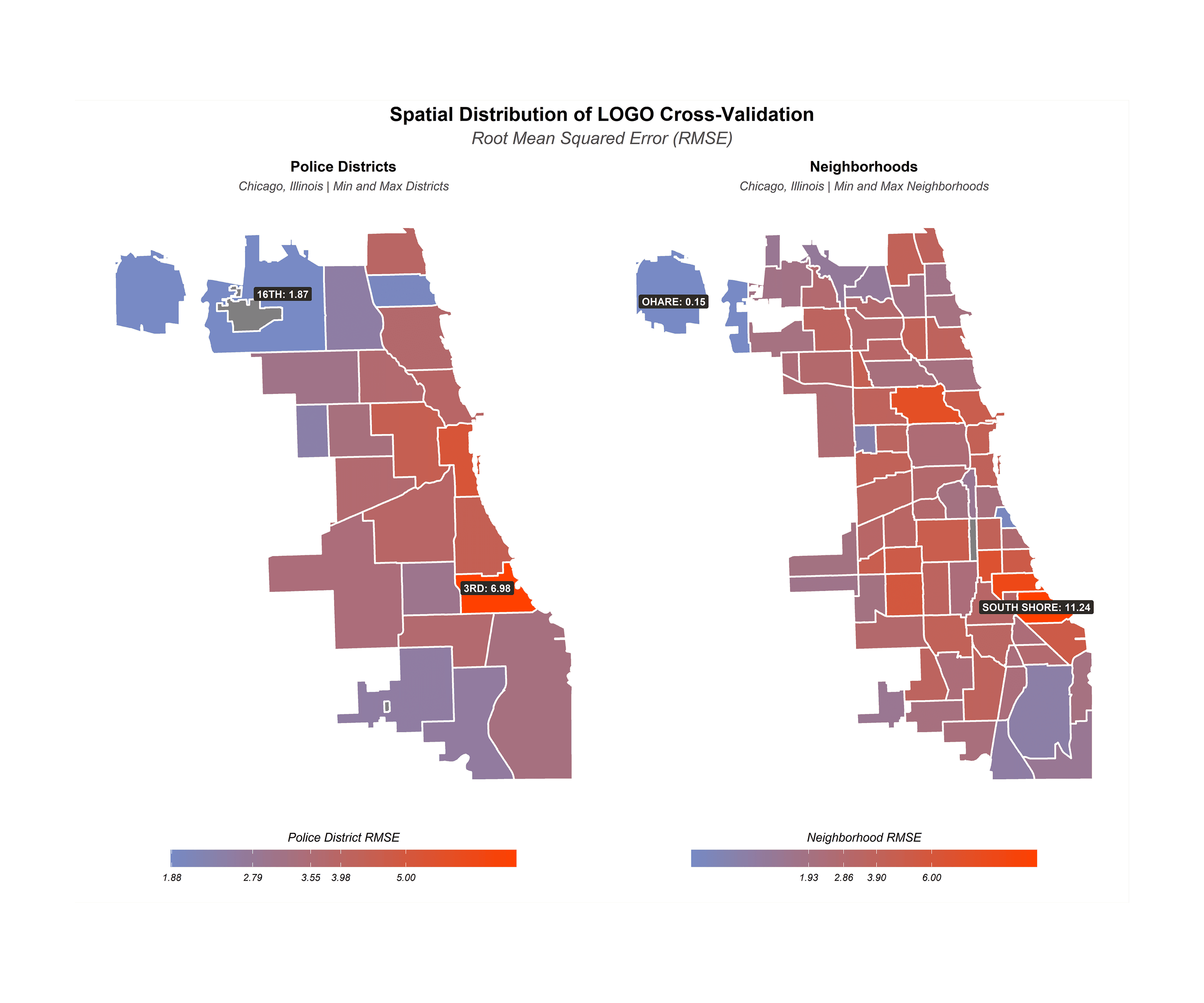
Validation: To ensure the model doesn't just memorize specific neighborhoods, Spatial Cross-Validation (Leave-One-Group-Out) is performed across both Police Districts and Neighborhood boundaries, testing the model's ability to generalize to unseen geographic areas.
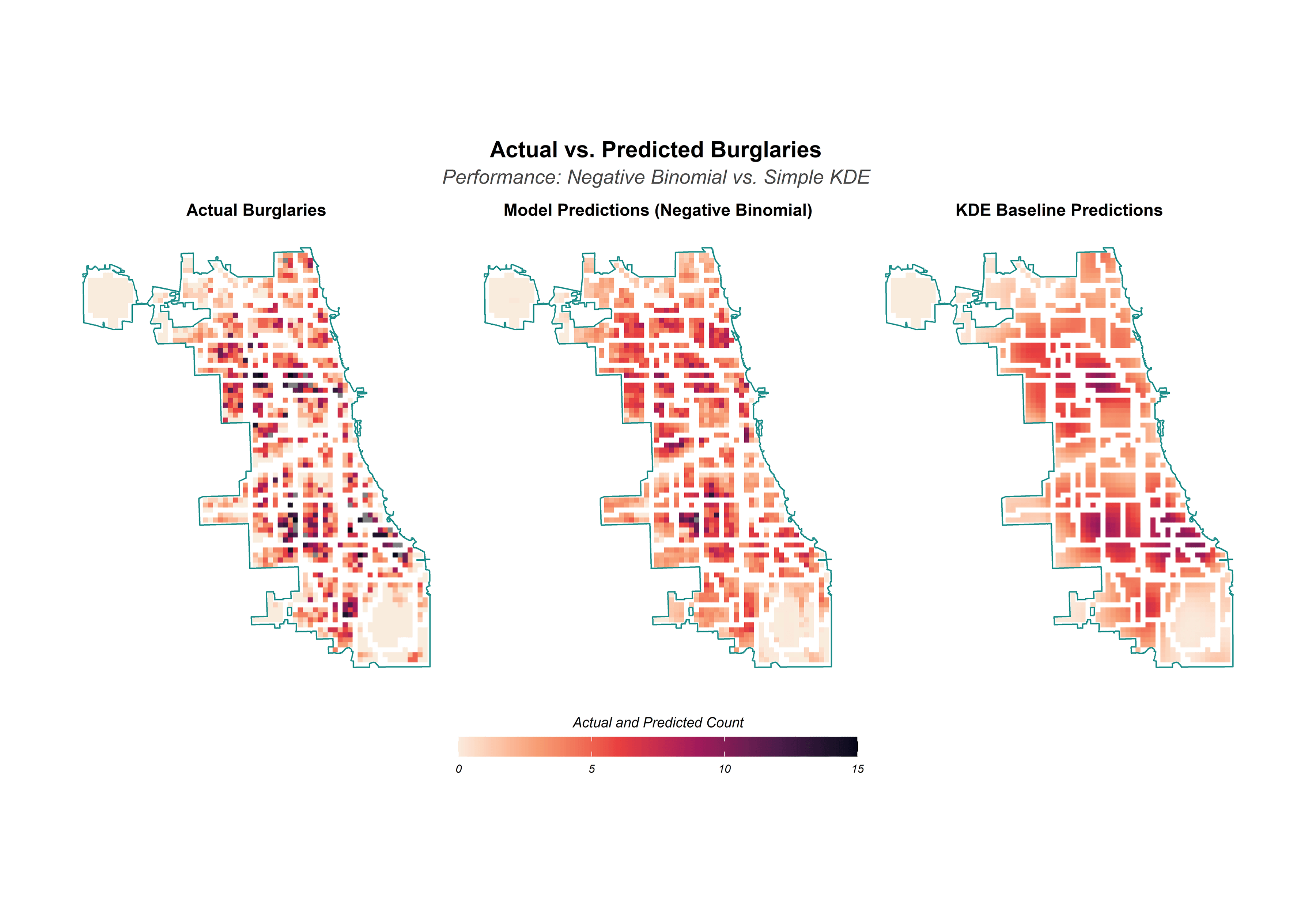
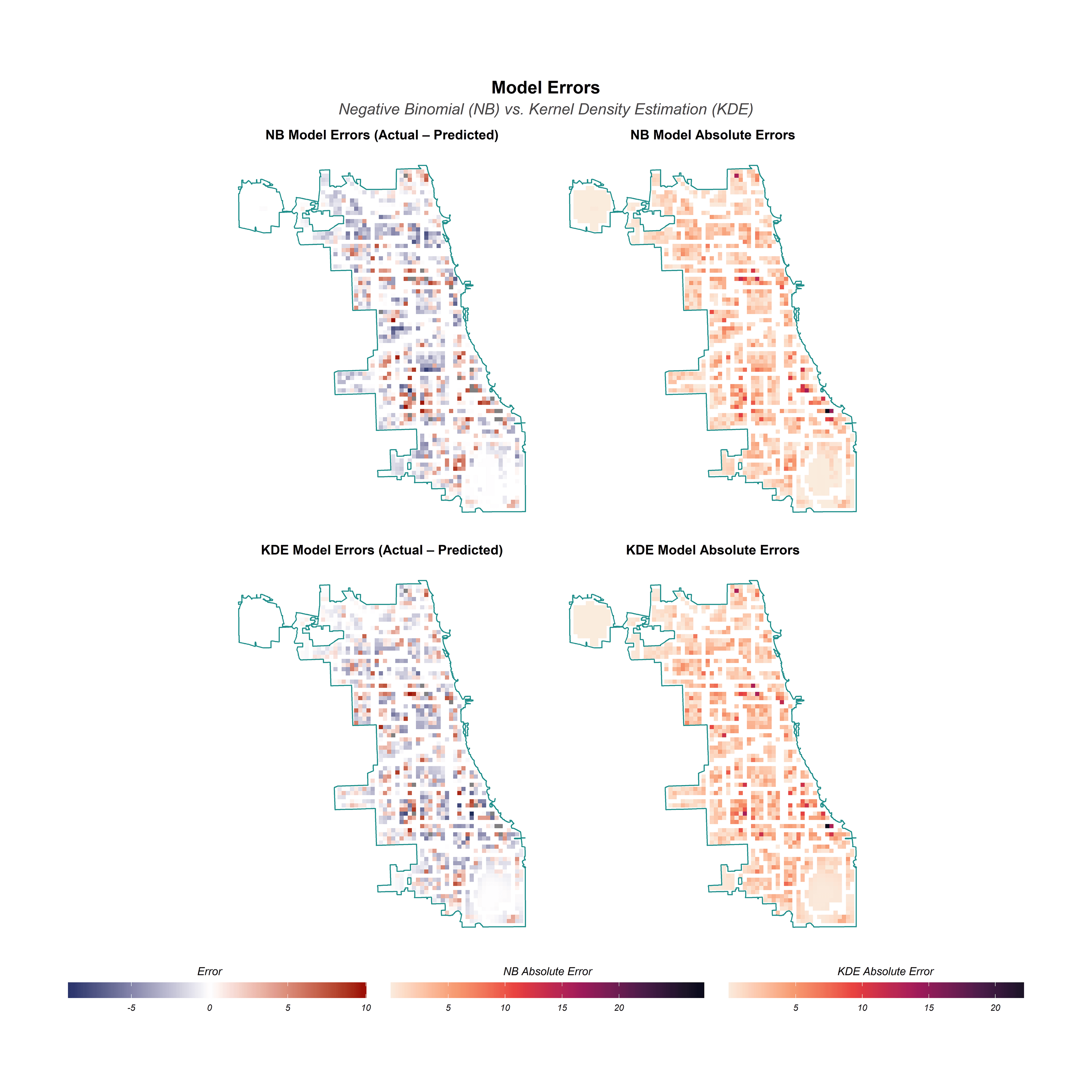
The Negative Binomial model significantly outperformed the Poisson model (lower AIC) and generalized better to future data (2018 burglaries) than a baseline Kernel Density Estimation (KDE). Key findings include:
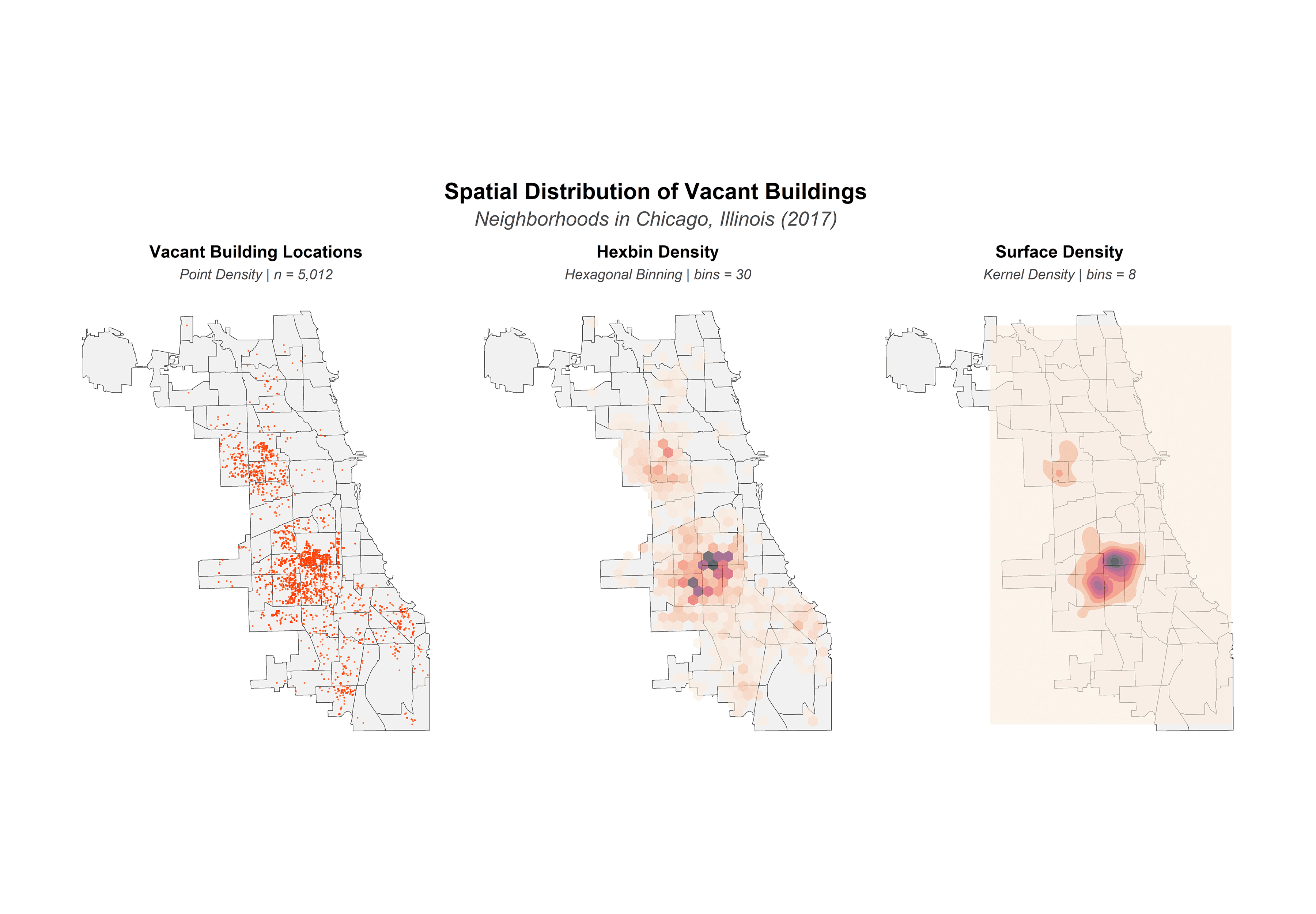
Infrastructure as Predictor: Proximity to vacant buildings and street light outage clusters had a statistically significant positive association with burglary rates.
Urban Form: Higher building density was the strongest predictor of burglary risk, while proximity to industrial zones was associated with lower risk.
Spatial Generalization: The model performed robustly across diverse neighborhoods, suggesting that the relationship between physical disorder (broken windows theory components) and crime is consistent across the city's geography.
This workflow serves as a prototype for non-punitive predictive governance.
Instead of directing police patrols to high-risk cells, municipal agencies can use these predictions to prioritize resource allocation—such as repairing street lights, securing vacant properties, and improving streetscapes. By identifying the physical environmental factors that correlate with crime, the model provides a roadmap for "crime prevention through environmental design" (CPTED), offering a more equitable alternative to traditional surveillance-based policing.
Role
Researcher
Tess Vu
Client
N/A
Keywords
CPTED, Negative Binomial, Poisson, Predictive Modeling, Regression, Urban Analytics
other works